
Workplace & Lifestyle
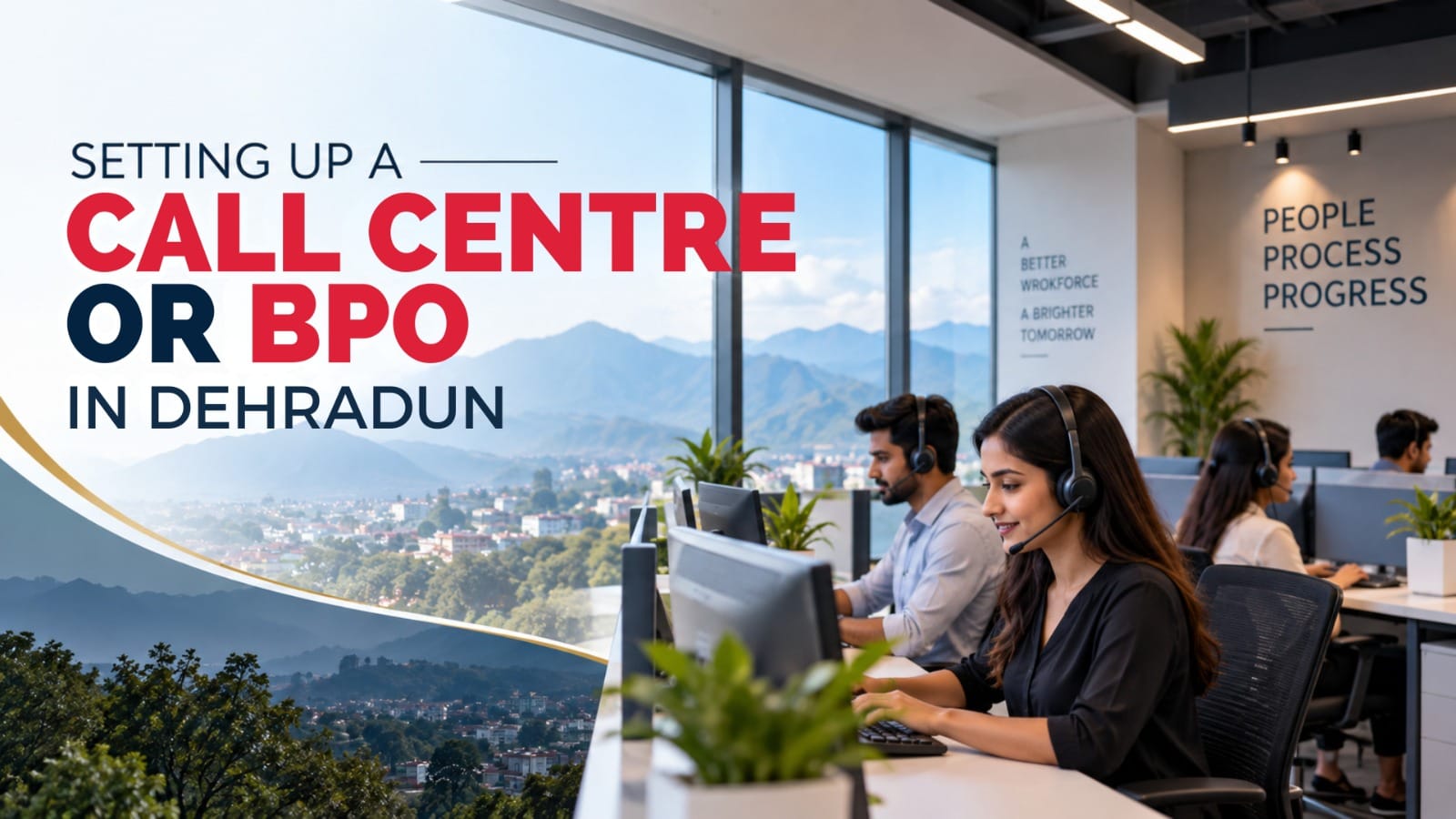
Setting Up a Call Centre or BPO in Dehradun
Setting up a call centre or BPO involves much more than finding an office and installing computers. The location, workspace layout, connectivity, power supply, employee access, security, and day-to-day operating requirements all need to work together.
Dehradun can be considered by businesses looking to establish a customer support, telecalling, back-office, technical support, or other BPO operation outside the major metropolitan cities. But choosing the city is only the beginning. The next step is finding a workspace that can support the way the operation will actually run.
If you are planning to set up a call centre or BPO in Dehradun, here are the key factors to consider before taking a commercial space.
Why Dehradun is an Ideal Location for Call Centre’s and BPOs
For businesses evaluating call centre or BPO space for rent in Dehradun or BPO space for rent in Dehradun, the city presents a genuinely strong case, and this comes down to three main factors working together rather than any single advantage.
The first is workforce availability. Dehradun produces a steady stream of English-speaking graduates each year from its universities and colleges, and the city’s established BPO sector means a portion of the workforce already has direct experience in voice-based and customer service roles. This makes recruitment and scaling noticeably faster than in markets where similar talent is harder to source.
The second is cost. Office rent, salaries, and general operating expenses in Dehradun are meaningfully lower than in India’s major metro cities, while infrastructure and connectivity remain reliable enough to support round-the-clock operations. The third is retention. A cleaner environment, shorter commute times, and a more comfortable pace of life all contribute to lower attrition, which is often one of the biggest hidden costs in the call centre and BPO industry.
Essential Steps to Establish a Call Centre or BPO in Dehradun
Setting up a call centre or BPO in Dehradun follows a logical sequence, and getting each stage right early tends to save considerable time later.
Business and legal registration. As with any commercial operation in India, this starts with company registration, applicable tax registrations, and any sector-specific licensing a BPO operation requires depending on the nature of its work — particularly where client data or international voice traffic is involved.
Space identification and permitted use. Because call centre and BPO operations have specific layout and connectivity needs, it’s worth identifying commercial properties or complexes that already accommodate this category rather than adapting a generic office unit after the fact. Confirming that a specific unit is approved for call centre or BPO use — rather than assuming any commercial space will do — avoids complications later.
Business permits and compliance. Beyond company registration, BPOs typically need to register under relevant state and central regulations covering IT-enabled services, along with local municipal approvals for the specific premises being occupied. This is also the stage to confirm fire safety and building compliance certifications for the unit, since a BPO operating multiple shifts needs fully compliant premises from day one, not as a work in progress.
Infrastructure fit-out. Once the space and approvals are in place, the fit-out stage covers everything from workstations and networking to power backup and training areas — covered in more detail below — sized to the operation’s planned headcount and growth trajectory.
Recruitment and go-live. With the physical setup underway, recruitment and training can run in parallel, so that the operation can move toward go-live without a gap between the space being ready and the workforce being in place.
Infrastructure and Technology Requirements for Call Centre’s in Dehradun
BPO operations are less forgiving of infrastructure gaps than most commercial businesses, largely because they run continuously, depend entirely on connectivity, and often work to client-mandated uptime standards. A handful of requirements deserve specific attention when evaluating a location.
- Workstations. Call centre floors need efficient, closely spaced workstation layouts designed around headset use, dual monitors where required, and enough desk density to support the planned headcount without compromising comfort over long shifts. This is one of the clearest cases where a property’s floor plate and column spacing matter as much as its total square footage — an oddly shaped or heavily obstructed floor can significantly reduce the usable seat count relative to its stated area.
- Power backup. For a BPO, a power interruption doesn’t just pause work — it can breach service-level commitments to clients operating across time zones, including through the night. Reliable, building-wide backup power isn’t a convenience for this category of business; it’s close to a baseline operating requirement, and it’s worth confirming the specific backup capacity and coverage before committing to a space, rather than assuming general “power backup” language in a property listing covers full-floor, round-the-clock operation.
- Internet feasibility. Voice and data operations depend entirely on connectivity, so confirming the feasibility of high-capacity, redundant internet links — ideally from more than one service provider — is a non-negotiable early step, not something to sort out after signing a lease. This includes verifying that a building’s existing infrastructure can actually support the bandwidth a BPO operation needs, since not every commercial property is wired for it by default.
- Training rooms. BPO operations run on continuous hiring and onboarding cycles, which makes dedicated training space a genuine operational requirement rather than a nice-to-have. A location with training rooms built in, or with enough flexible floor space to configure them, saves an operator from having to carve training capacity out of production floor space later.
- Employee access. With most BPOs running multiple shifts, including night shifts to serve international clients, ease of employee access matters well beyond daytime business hours — safe, well-lit entry points, reliable building access outside standard hours, and proximity to transport options all affect whether a workforce can reliably show up for a 2 a.m. shift change.
- Customisable layouts. Because BPO floor plans differ meaningfully from standard office layouts — dense workstation seating, dedicated training zones, team-lead pods, and often a separate quality or operations area — the ability to configure a unit’s internal layout to the operator’s own specification, rather than working around a fixed generic office fit-out, is a genuine advantage worth confirming with any landlord or developer before signing.
Locations that combine these requirements in a single, purpose-fit commercial development — rather than requiring extensive retrofitting of a generic office unit — tend to save BPO operators real time and cost in the run-up to going live.
Challenges to Anticipate When Setting Up a Call Centre or BPO in Dehradun and How to Overcome Them
Dehradun’s advantages come with some genuine trade-offs worth planning for rather than discovering later. Infrastructure quality, particularly power reliability and bandwidth, tends to be more developed in central, established commercial zones than in outer parts of the city — the practical response is to prioritise locations with verified, building-wide power backup and confirmed high-capacity connectivity rather than assuming infrastructure quality is uniform across the city.
Talent pool size is another consideration: while Dehradun’s graduate pipeline is real, it’s smaller than what a metro city offers, which means retention strategy matters more here than in a market where replacement hiring is easy. Building genuine career paths and competitive local compensation helps offset this rather than relying purely on volume hiring. International exposure and direct global connectivity also remain more limited than in India’s most established BPO hubs, which can matter for operations requiring frequent in-person client visits — though this is becoming less of a constraint as remote client management becomes more standard practice across the industry. None of these challenges are unusual for a growing Tier-II BPO location, and each has a workable answer with the right planning at the setup stage.
Conclusion: Why Dehradun should be Call Centre or BPO Destination
Dehradun brings together the fundamentals a call centre or BPO operation actually needs: a trainable, English-proficient talent pool, a materially lower cost base than metro alternatives, improving infrastructure backed by consistent state support, and commercial developments purpose-built to accommodate this category of business.
For businesses specifically searching for call centre space for rent in Dehradun or BPO space for rent in Dehradun, WFE City lists call centre and BPO space as one of its dedicated commercial categories, giving operators a way to step directly into a location built around workstation-dense, connectivity-dependent operations rather than retrofitting a generic office unit from scratch.
For any business evaluating where to set up its next call centre or BPO operation, Dehradun offers a genuine alternative to the established metro hubs, one where cost, talent, and infrastructure fundamentals are aligned rather than working against each other. Exploring what the city, and locations like WFE City within it, can offer is a reasonable next step for any operator serious about finding the right call centre or BPO space for rent in Dehradun to build a lean, capable operation outside the traditional clusters.

Rajan
WFECity’s editorial team shares practical insights about office spaces, commercial real estate, amenities and business growth in Dehradun.
You May Also Like
Workplace & Lifestyle
Important Amenities to Check Before Choosing Commercial Space in Dehradun
Sep 21, 2026
Workplace & Lifestyle
Commercial Space for Gyms, Salons, Yoga Studios, and Entertainment Businesses
Sep 19, 2026