Workplace & Lifestyle
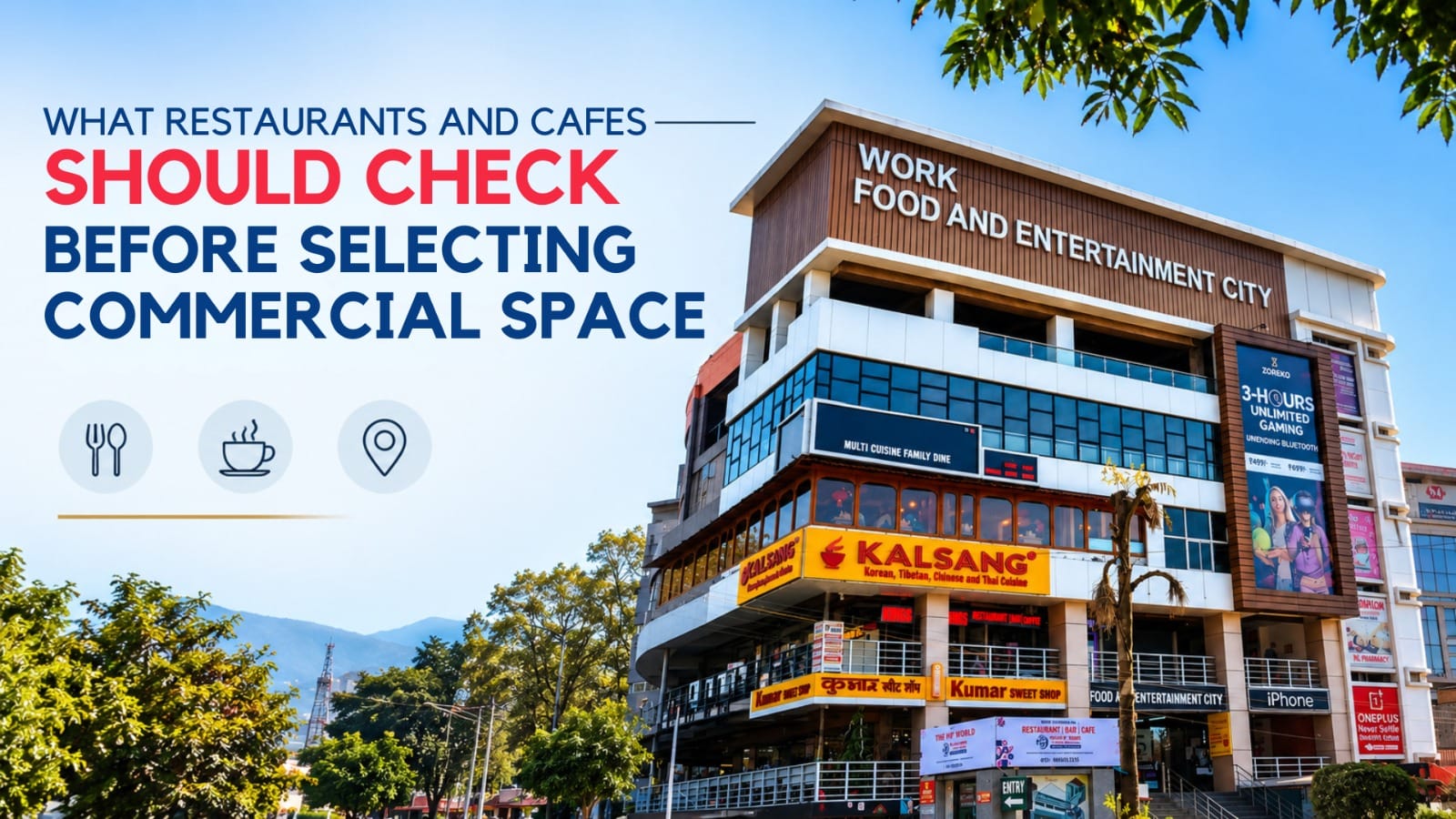
What Restaurants and Cafes Should Check Before Selecting Commercial Space in Dehradun
Opening a restaurant or café involves dozens of decisions, but few carry as much long-term weight as the space itself. Finding the right restaurant space for rent in Dehradun is about more than choosing a good-looking property.
Most restaurant failures don’t begin in the kitchen. They begin the day the lease is signed. The location, layout and basic infrastructure can directly affect how smoothly a restaurant or café operates once it opens.
Finding restaurant space for rent in Dehradun, or cafe space for rent in Dehradun is rarely the difficult part. Finding space that won’t quietly work against the business for the next three years is and the real challenge is knowing which details actually matter before signing, and which ones only reveal themselves after the business is already committed.
At WFE City, we understand that choosing commercial space is an important business decision. This guide covers the key things restaurants and cafés should check before signing a lease, from licensing and infrastructure to visibility, parking and lease terms.
Verify Licensing Before Visiting the Space
This is one of the first things a restaurant or café owner should check. A property may have high ceilings, strong natural light, and an excellent location — and still turn out to be unsuitable for a food business.
Before considering a restaurant space for rent in Dehradun, it is worth confirming that the property is approved for commercial use. It also helps to establish whether the previous tenant operated a food business — if so, a portion of the licensing process is typically more straightforward; if not, the process effectively starts from scratch, which can add several months to the timeline.
FSSAI registration on its own is generally manageable. It’s the fire NOC, health department clearance, and pollution control board sign-off that tend to accumulate delays. Some landlords will offer to handle these approvals — any such commitment should be documented in writing.
Licensing and approvals should be checked before signing a lease. Finding an issue after committing to the property can lead to delays and additional costs.
Assess the Surrounding Area and What It Means for the Business Model
Strong foot traffic is only useful if it’s the right kind of foot traffic. A location near a college may support high volumes of tea and snack sales but work poorly for a premium dinner menu. A commercial hub may generate strong weekday lunch traffic and go quiet on weekends. A stretch near a tourist route may see seasonal spikes followed by long stretches of low footfall.
Before choosing restaurant space for rent in Dehradun, it is important to understand what kind of customers and businesses are already around the property. A practical step is to walk a roughly 500-metre radius around the property and take stock of nearby offices, residential complexes, schools, gyms, and food outlets — including cloud kitchens, which are easy to overlook but compete directly for the same delivery demand. Several café owners in Dehradun have found their delivery volumes plateauing only after realising how many cloud kitchens were already operating on the same street.
This is where a centrally located commercial destination can give a restaurant or café an advantage. WFE City puts businesses in a well-connected part of Dehradun, making it easier to stay close to the city’s everyday commercial activity. For a café, that can mean being closer to working professionals looking for a quick coffee or lunch. For a restaurant, it can mean better access for customers, employees and visitors throughout the day.
Inspect the Infrastructure Before Finalising the Menu
Infrastructure issues are rarely inexpensive to fix after the fact. It’s advisable to walk the space with someone who understands commercial kitchens — an experienced chef or a contractor with restaurant fit-out experience — and to check the power load specifically.
Water pressure should be checked on every floor. Dehradun experiences seasonal water fluctuations, and a building relying solely on a single borewell can run into difficulty during drier months. Requesting the average monthly water bill — and treating a landlord’s reluctance to share it as a signal — is a reasonable diligence step.
Drainage is worth testing directly: pouring water down the kitchen sink and observing how quickly it clears. Slow drainage typically points to a clogged or undersized sewage line, which is considerably more difficult and costly to address after kitchen installation.
Ceiling height matters as well. Anything below 10 feet tends to trap heat, feel cramped, and complicate ventilation. Concepts involving an open kitchen or a wood-fired oven require proper exhaust ductwork, and some buildings restrict external ducting altogether — which can rule out certain formats of cooking entirely.
Flooring should also be assessed: ceramic or vitrified tiles are generally manageable, while marble presents a slip hazard when wet. An uneven floor can prevent equipment from sitting correctly, requiring levelling work before fit-out can even begin.
Review the Lease Terms as Carefully as the Landlord’s Accountant Would
Most lease agreements are drafted to protect the landlord’s interests first. It’s the tenant’s responsibility to negotiate the clauses that protect theirs.
When considering a restaurant space for rent in Dehradun, pay close attention to the following:
- Lock-in period. Understand how long you are committed to the property and whether there is an option to exit the agreement earlier. A three-year lock-in is standard among Dehradun landlords. This is reasonable if the business performs as expected, but it can become a significant liability if it doesn’t. Negotiating an exit clause — for instance, the ability to terminate.
- Rent escalation. Check how much the rent can increase and when the increase will apply. A 10% annual increase is fairly standard in stable locations. In areas where landlords are anticipating development — proximity to a planned metro corridor, for example — escalation of 15% to 20% is more common.
- Maintenance and repairs. The lease should clearly specify which party is responsible for what. Structural repairs — roof leaks, external plumbing, electrical panel upgrades — are typically the landlord’s responsibility, while internal fit-out, HVAC servicing, and pest control fall to the tenant. It’s not uncommon for landlords to attempt to shift structural repair costs onto tenants; this is worth resisting during negotiation.
- Security deposit. Confirm the deposit amount, refund terms and possible deductions. Three to six months’ rent is the typical range. Refund terms should also be clarified upfront, since deductions for “damages” that existed prior to occupancy are a common point of dispute.
- Renewal terms. Understand what happens at the end of the lease term — whether the tenant has first right of refusal, whether a renewal fee applies, and whether future rent increases are capped or left to the landlord’s discretion. Businesses that have built a loyal customer base over several years have, in some cases, lost their location entirely because renewal terms weren’t clearly defined upfront.
Evaluate Visibility and Accessibility to Protect the Marketing Budget
A location with poor visibility can make customer acquisition more difficult. Visibility from the main road matters considerably. A first-floor location, or one tucked behind another building or along a low-traffic lane, requires more marketing spend to achieve the same customer acquisition that a visible ground-floor corner location achieves passively.
Access points deserve equal attention — a clear, safe street-level entry matters particularly for businesses targeting families or older customers, for whom stairs can be a genuine deterrent. Dehradun’s footpaths can present additional challenges, including uneven surfaces, encroachments, and monsoon-season flooding; visiting the approach during light rain is a useful test.
Parking remains one of the most consistently underestimated factors. Customers are generally unwilling to circle repeatedly in search of a spot, and the absence of dedicated parking — or a clear arrangement with a nearby lot — tends to show up directly in weekend footfall. Valet service is only a viable substitute if it has been properly cost and staffed.
Finally, it’s worth understanding the reputation of the immediate neighbourhood. Some areas are known for weekend and late-night activity, which suits certain formats well and others poorly; others see strong delivery volume but limited dine-in traffic. Conversations with nearby shopkeepers often surface this kind of insight more reliably than any amount of independent research.
Test the Neighbourhood at Different Times Before Deciding
Every location has its own rhythm, and understanding that rhythm requires more than a single visit.
Visiting the space across a weekday morning, a weekday lunch hour, a weekday evening, and a weekend afternoon helps establish how crowd levels, traffic, and noise actually vary. A location that appears ideal at 11 a.m. may be considerably more congested by 7 p.m., and a spot that thrives on Saturday may see very little activity on a Tuesday.
Conversations with nearby business owners tend to be particularly informative. Their tenure is itself a useful signal: a cluster of businesses that have all opened within the past two years may indicate high turnover, while a cluster with a decade or more of continuous operation suggests a genuinely proven location.
The evening character of the area matters as well. Certain corridors in Dehradun, including parts of Rajpur Road, Chakrata Road, and Race Course, sustain strong evening trade, while others see activity drop sharply after 8 p.m. For businesses considering restaurant and cafe space for rent in Dehradun, testing the location at these different times can help determine whether the surrounding activity matches the business model. WFE City can be worth considering for businesses that want a commercially active location in Dehradun, but the same timing checks should be made before signing a lease. Any business model built around dinner or late-night service should have this assumption tested directly before signing.
Making the Right Decision
Selecting restaurant or café space in Dehradun is not primarily about identifying the most attractive property — it’s about identifying the one that won’t work against the business once it’s operational.
Verifying zoning early, assessing the surrounding area honestly, inspecting infrastructure thoroughly, negotiating lease terms with the same rigour a landlord would apply, and testing the location at different times of day all contribute to a decision made on evidence rather than impression. A space that appears ideal on a Tuesday morning may prove entirely unsuitable on a Saturday evening — and establishing that difference before signing is what ultimately protects the business.
For businesses considering a centrally located commercial destination such as WFE City, these checks can help determine whether the space and its surroundings genuinely fit the way the restaurant or café plans to operate. WFE City’s leasing team can walk operators through the available area, water and drainage arrangements, electrical load, ventilation and exhaust feasibility, and parking before any commitment is made.
For operators evaluating restaurant or café space for rent in Dehradun who would value a second perspective on the deal, the terms, or the location itself, call or WhatsApp the WFE City leasing team at +91 96505 20015 to schedule a site visit before making a decision.

Rajan
WFECity’s editorial team shares practical insights about office spaces, commercial real estate, amenities and business growth in Dehradun.
You May Also Like
Workplace & Lifestyle
Commercial Space for Gyms, Salons, Yoga Studios, and Entertainment Businesses
Sep 19, 2026